
THE SECRETS AND MYSTERIES OF ANTS
Beneath the soil, beneath the grass blades we crush without a second thought, lies a civilization that saw the rise and fall of the giants. While the dinosaurs ruled the surface for eons, the ants were already architecting the dark. They appeared 140 million years ago—survivors of the great extinction, witnesses to the birth of flowers, and engineers of a world that thrives in the shadows of our own.
We barely notice them. A trail across the kitchen counter. A mound in the garden. A line of tiny bodies carrying crumbs ten times their weight. We call them pests. We spray them. We crush them.
And yet—they are watching us back.
The Underground Network
Deep beneath your feet, the earth is laced with tunnels so vast and complex that if you mapped every ant nest on Earth, the passageways would stretch for millions of miles. They have cities beneath our cities. They have highways, nurseries, farms, graveyards, and ventilation systems engineered with a precision that would make our civil engineers weep with envy.
But here is the secret of their “Biological Internet”:
The tunnels are not just voids. Scientists have discovered that the soil is alive with mycelium, fungal networks that carry chemical and electrical impulses across entire forests. While we have only just begun to understand the “Wood Wide Web,” the ants have lived within it for millennia. They don’t just walk through the dirt; they navigate a living, pulsing grid.
What if the ants are plugged into a frequency older than language itself? What if their antennae are tuned to the very heartbeat of the planet?
The Fungus Farmers
There is a species of ants that does something no other creature on Earth has figured out how to do.
They farm.
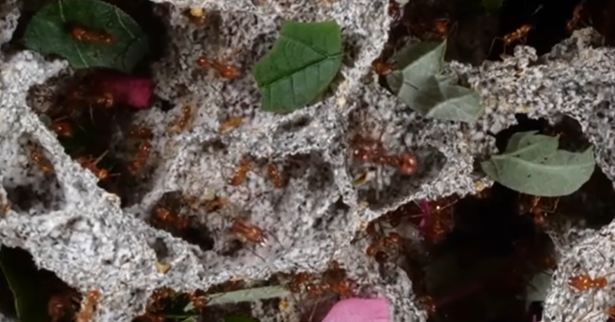
Not like we farm—plowing fields and harvesting crops. These Leafcutter ants cultivate fungus. They cut leaves, carry them underground, chew them into a pulp, and feed that pulp to a specific type of fungus. This partnership has lasted for 50 million years. That is longer than the Himalayas have stood.
But here is the mystery: This fungus has no wild form. It exists only because the ants created it. It is a domesticated organism, like wheat or corn—but domesticated not by us, but by insects.
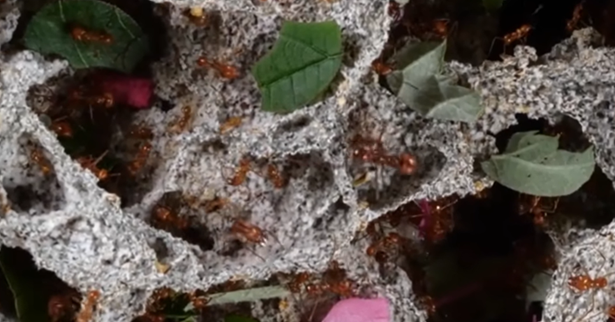
So who domesticated who? Does the fungus control the ants? Does it whisper to them through chemical signals, steering their tiny bodies to maintain specific temperatures and defend the nest at all costs?
And if a fungus can domesticate an ant… what has domesticated us?
The Corpse Carriers
Watch an ant trail closely. When an ant dies, its sisters do not leave it where it fell. They have designated graveyards—far from the nest. They have funeral workers driven by a concept of “clean” and “contaminated” that mirrors our own horror of the dead.
But here is the chilling part: The command is purely chemical. If you paint a living ant with oleic acid—the scent of decay—its sisters will carry it to the graveyard while it is still alive and struggling. They do not check for a pulse. They do not wait for the body to cool. They smell the “death signal,” and they obey.
This is the secret they hide in plain sight: they are not individuals. They are governed by signals so ancient that a living ant can be marched to its grave simply because its scent has been overruled.
We look at them and see tiny robots. But we, too, follow invisible signals—algorithms, ideologies, and fears. We, too, can be marched toward destruction by a signal we cannot name.
The Queen’s Silence
In the heart of every nest lies the Queen. She is not a ruler; she is the Chemical Anchor. She produces a constant stream of pheromones that tell the workers: You are home. You are safe. You belong.
But if the Queen dies—if her signal stops—the colony enters a state of “disorganization.” They don’t panic. They simply… fade. Without the chemical “hum” that defines their existence, the workers slowly lose their reason for being. They wander out of the nest and walk until their legs give out. They die of exhaustion, not starvation.
It looks like a people who have lost their story.
But the silence does not mean the story ends.
The Collective Memory
Here is the greatest secret: The colony remembers. An ant’s brain is the size of a sand grain or chia seed, but the nest is a biological hard drive. Their memory is stored in the soil—in pheromone trails reinforced for so long they have become an inheritance. A trail is not just a direction; it is a story passed from mandible to antenna for millions of years.
We have destroyed their nests and poisoned their queens. And still they return. Still they build. They survived the asteroid that killed the dinosaurs; they will survive us.
What They Know That We Do Not
The ants know something we have forgotten: The individual dies, but the colony endures. The body fails, but the signal continues.
We spend our lives chasing immortality—building monuments and carving names in stone. The ants do not have names. They have no history except the living memory of the nest. And yet, they will outlast us.
When our cities have crumbled, the ants will still be there, following trails laid down before the first human ever stood upright.
They will not remember us.
We were never important enough to remember.
The Final Check
The next time you see an ant on your counter, do not crush it. Follow its trail to the world that exists parallel to yours—ancient, patient, and utterly indifferent to your ambitions.
Ask yourself: Who really owns this planet? The species that has been here for 140 million years? Or the one that has been here for a mere 300,000 and is already planning its escape?
The ants are not afraid of us.
And that, more than anything, should marvel you.
Want to explore the wilderness, lets take you there. Check us out – Home